


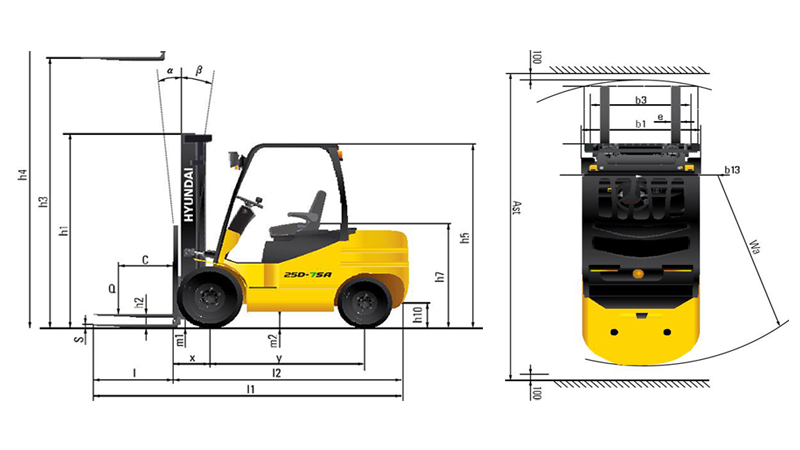
When selecting and operating a forklift, many people focus only on the brand or price while overlooking important technical specifications. In reality, forklift specifications directly affect working performance, operational safety, and the ability to operate efficiently in different environments.
Understanding forklift technical specifications helps businesses choose the right type of forklift based on load capacity, warehouse rack height, pallet type, and workspace conditions. As a result, companies can optimize investment costs, improve operational efficiency, and minimize risks during operation.
BASIC FORKLIFT TECHNICAL SPECIFICATIONS
A forklift typically consists of key components such as the engine, hydraulic system, mast, and counterweight. Below are the most important specifications to consider when choosing a forklift.
1. FORKLIFT LOAD CAPACITY
Load capacity is the most important specification when selecting a forklift. Forklifts operate based on the principle of weight balance, meaning they cannot safely lift loads beyond their designed capacity.
In addition, users should choose a forklift with a slightly higher capacity than their actual needs to ensure safety and increase the machine’s durability. Operating within the recommended load range allows the forklift to run more stably, reduces maintenance frequency, and extends the lifespan of components.
It is also important to note that the actual lifting capacity decreases when lifting loads to higher heights, according to the forklift load chart. Therefore, selecting the correct load capacity is essential for safe operation.
2. FORKLIFT LIFT HEIGHT
Besides load capacity, lift height is another critical specification. These two factors are closely related during forklift operation.
Typically, forklift mast heights range from 3,000 mm to 6,000 mm. Currently, there are two common mast types: standard masts and container masts.
If a business needs to lift goods above 4.5 meters, a 3-stage mast (3-cylinder mast) is highly recommended. This design reduces the forklift’s overall lowered height, allowing easier movement inside containers or warehouses with limited ceiling height.
3. FORKLIFT ENGINE
The engine determines the forklift’s operating performance and fuel consumption. Today, forklifts may use engines from Japan, Korea, or other manufacturers with relatively similar power outputs.
However, the main differences lie in durability, fuel efficiency, and initial investment cost. Therefore, businesses should carefully consider their operating requirements and budget when selecting the appropriate engine type.
4. FORKLIFT HYDRAULIC SYSTEM
The hydraulic system plays a vital role in the lifting and lowering process of a forklift. Each forklift manufacturer typically uses its own hydraulic technology to optimize performance and production costs.
Before purchasing, users should carefully review the technical catalogue or test the machine in practice to evaluate the hydraulic system’s performance. This helps ensure a more suitable and stable forklift for long-term operation.
5. ENGINE TYPE AND POWER SOURCE
Forklifts are currently classified based on their power source:
Electric forklifts: powered by lead-acid batteries or lithium batteries, offering quiet operation and zero emissions, making them ideal for indoor warehouses and clean environments.
Diesel/LPG forklifts: provide powerful performance and are suitable for outdoor work or continuous heavy-duty operations.
Choosing the right power source directly affects operating costs, maintenance requirements, and overall work efficiency.
6. FORKLIFT TIRES
Tires are another important factor affecting forklift performance. Depending on the working environment, users can choose the most suitable tire type:
Solid tires: highly durable and puncture-resistant, suitable for indoor factories and warehouses.
Pneumatic tires: provide smoother operation and are ideal for rough terrain or outdoor environments.
PU tires: commonly used for electric reach trucks and suitable for clean warehouses with smooth flooring.
Selecting the correct tire type not only increases forklift lifespan but also helps protect warehouse flooring and improve operational efficiency.
CONCLUSION
Understanding forklift technical specifications is essential for businesses to choose the right equipment for their operational needs. A suitable forklift not only improves productivity but also reduces maintenance costs, enhances safety, and extends equipment lifespan for long-term operation.
- Hotline: 090.345.1688
- Email: tuvn@1688.com.vn
- Website: www.nlp168.vn